
At the Society of American Archivists conference last August, I joined a panel on artificial intelligence. The first question from the audience came quickly and, frankly, with a little heat: "How do you justify using energy-intensive tools like AI when the climate crisis is only getting worse?"
That moment stuck with me. The archivists in the room were being conscientious—a trait I deeply respect. Since then, I’ve been thinking through a better answer, and talking to other smart people about it. Don Simmons, Assistant Professor in the library school at Simmons University, pointed me to this Washington Post article that dives into exactly this question: just how bad is AI, environmentally?
According to the article, while 2024 estimates for how much electricity a ChatGPT question uses started at 10 times the amount of a search, they have dropped to a tenth of that over the last two years. According to the article, "the trend is clear: massive efficiency gains. Google claims emissions from a Gemini text response fell by a factor of 44 over the past year."
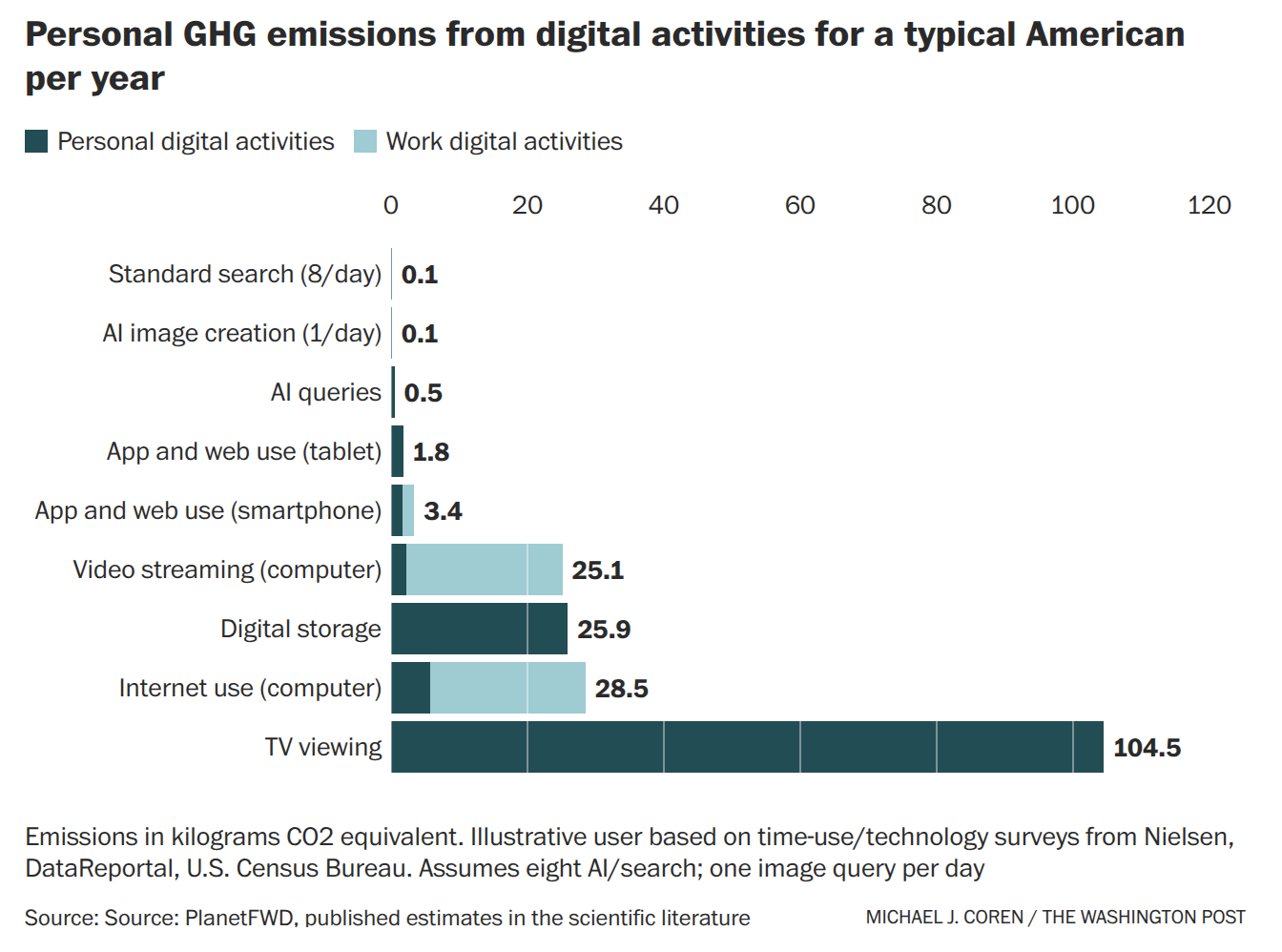
Where AI starts to matter more is when it’s used at scale. The article notes, "data centers are expected to consume 8 percent of total electricity in the United States by 2030, up from 3 percent today."
Water use is similar. While ChatGPT might use a few drops per query (roughly one-fifteenth of a teaspoon), the scale matters. If every app and interaction uses AI, those drops add up. And yet, that daily AI-related water use is still a fraction of what we use growing cotton for t-shirts or maintaining golf courses.

Miranda Gorman of Planet FWD (a partner in the article) offers a crucial perspective here: “We sometimes lose the perspective that a lot of these technological advances actually allow for a ton of increased efficiency.” If you work from home thanks to technological advances instead of commuting by car, your energy savings from avoiding the drive could dwarf any emissions from the technology tools you use.
That perspective is especially important in archives. Using AI to improve accessibility, discover hidden connections, or support transcription efforts isn’t frivolous. It’s mission-driven. It’s about ensuring that marginalized voices, handwritten histories, and obscure documents are no longer locked away. It’s about equity.
And here’s where I circle back to FromThePage. We believe in AI as a tool, not a mandate. Our software supports AI-assisted transcription, but always as an optional feature. Human judgment remains central. You can use it to speed up your work, or ignore it entirely. We don’t assume AI is the answer—we offer it as one of many tools, especially for institutions navigating both ethical and practical constraints.
So yes, let’s ask hard questions about AI’s environmental impact. Let’s demand transparency and push for cleaner infrastructure. But let’s also hold space for the good that conscientious, purposeful use can do.
Read the full Washington Post article here (paywall).
And if you’re thinking through how to responsibly incorporate AI into your digitization or transcription workflows, we’re always happy to talk.