
AI is changing so fast, and so is FromThePage.
Here’s a look at the AI features we currently offer.

Last week, I was corresponding with my friend Laura Morreale about the results of Gemini transcription on this Crusader-era manuscript. The differences between the AI results and Laura’s are fairly interesting: there are some mis-readings, like y for ii, but about half of the differences are reasonable editorial decisions. Gemini represents long s as the character ſ and retains the abbreviation of “Jerusalem” as ierlĩm, while Laura modernizes both.
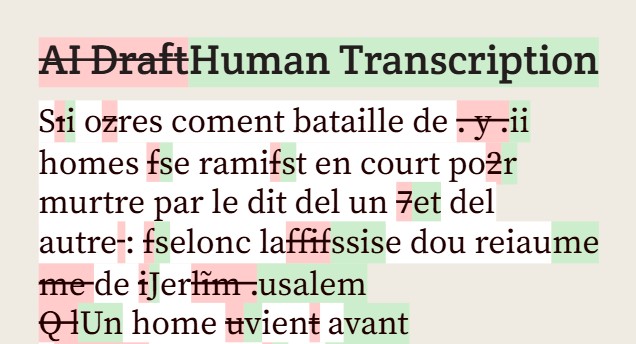
This is interesting–Laura’s version is much more useful for most purposes, although the Gemini transcript isn’t necessarily “wrong”--but along the way she said something that really stuck with me:
Yes, I agree, many of these errors are just a question of getting the hand/letter forms right, and others are editorial. But it really leaves me with the conclusion that - especially with a deluxe manuscript like this one -- I'm not really benefitting much from using the AI, and in fact I'm really losing something in the process (or rather, losing something in that I have not processed the text myself). My real hope with AI is that it will be able to tackle the very ugly (and tedious) manuscripts we have talked about previously (the financial records). That would be a help - this is kinda just in the way.
And the thing is, she’s right.
This document is a joy to read–my Old French is pretty rudimentary, but even I enjoy puzzling out that uiſconte means “viscount”. It’s so pretty that it draws you in. On the other hand, the financial records many of us work with are more of a slog:
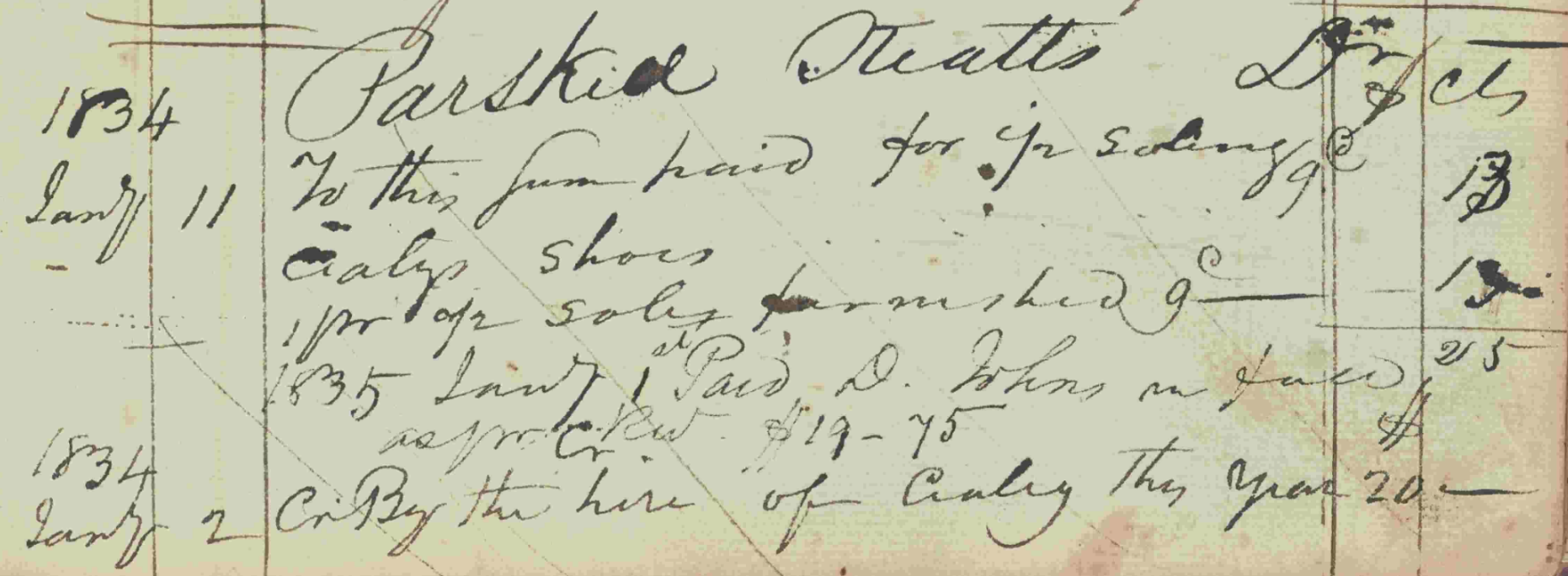
This entry in the account books of Jeremiah White Graves mentions an enslaved man whose name may read “Aubry” or “Caly”. These two daybook entries may be the only place that his name is recorded. But they appear at the bottom of accounts paying tailors and blacksmiths, and their format is difficult to transcribe. In addition to the challenging script, the entries span multiple lines, include prices in shillings and pence of Virginia money alongside totals in US dollars and cents, and are laid out in five columns. The amazing volunteer who worked on Jeremiah White Graves’ diaries was too intimidated to touch these volumes, and I’ve been procrastinating on starting them. As a result, we didn’t know about Aubry.
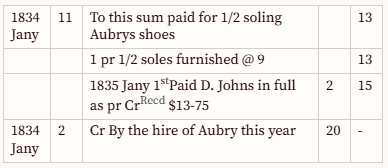
I was able to use the AI Draft (powered by Gemini) to generate a page with the proper tabular formatting and a draft transcription. It wasn’t perfect, but I was able to focus on the content of the accounts instead of the encoding while I edited the draft. This is the kind of use of AI that Laura hopes for, not replacing the experience of working with a deluxe manuscript.
That distinction between automating drudgery in service of scholarship versus automating away scholarship altogether was in the back of my mind when I started reading Pope Leo’s encyclical on AI and technology, Magnifica humanitas. I’m not done with it yet, but one passage struck me as relevant here:

The question of when it is appropriate to use AI and when humans should do the work is essential. We believe that AI features should always be optional, never required, but there may be situations where AI features should actually be disabled or prohibited. Even as AI engines become more powerful and their results become more accurate, efficiency is not the ultimate measure and “easier” is not necessarily “better”.